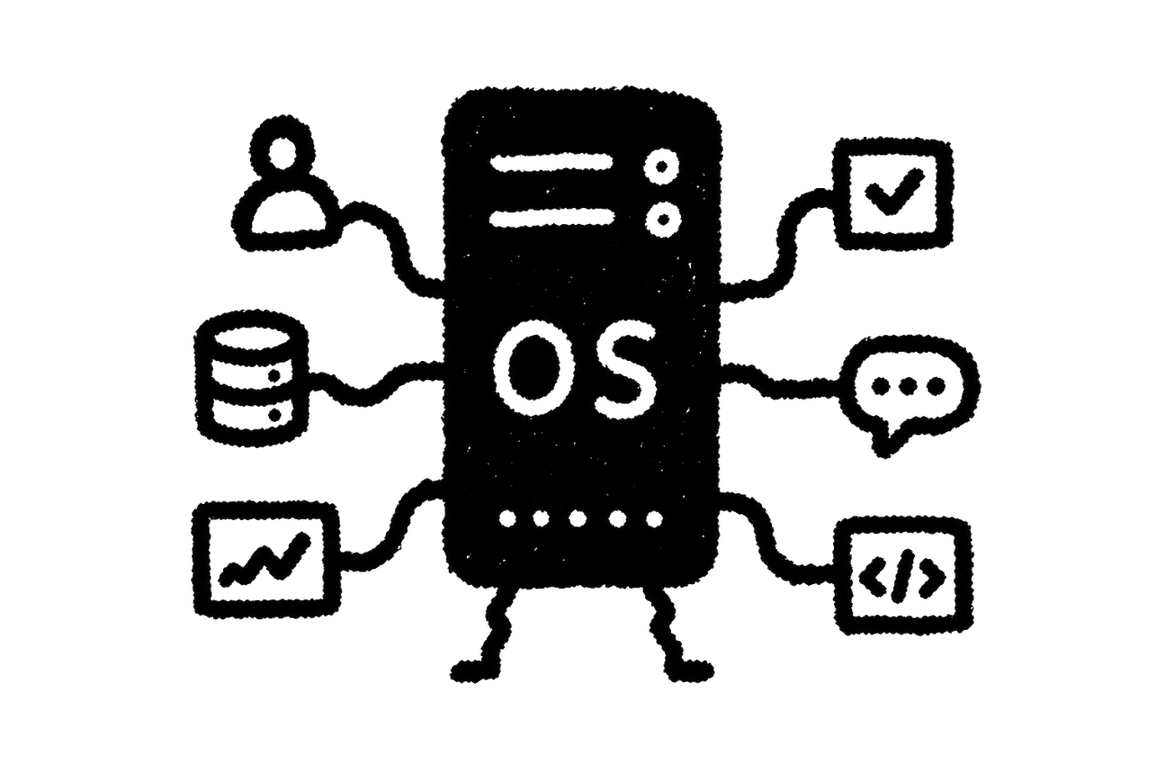
AI Is Not a Tool. It's Your Enterprise OS.
74% of companies are struggling to get value from AI. The 6% winning have redesigned their entire enterprise as an intelligent system.
I've had the same conversation with dozens of C-suite and enterprise leaders over the past year. They've added Copilot to the productivity suite. A chatbot on the service desk. An AI toggle inside the CRM. Box ticked. Nothing fundamentally changed.
Using software with AI embedded is not the same as building AI-native workflows. And it is nowhere near building an AI-native enterprise. Most companies are stuck at level one. The frontier firms are already at level three — and pulling away fast.
74% are struggling to scale value from AI (BCG, 2024). 50% of GenAI projects die after proof of concept (Gartner, 2026). 42% abandoned most AI initiatives in 2025, up from 17% the year before (McKinsey). Not because AI doesn't work. Because these companies are treating AI as a tool. It's not a tool. It's an operating system.
Diana Hu, partner at Y Combinator, framed it sharply in April 2026: AI is not a tool your company uses. It is the operating system your company runs on.
The 6% of enterprises seeing real EBIT impact from AI are 2.8x more likely to have redesigned workflows around AI rather than layering it on top (McKinsey, 2025). Process redesign plus AI delivers up to 25% cost savings. Isolated tool adoption? 5% or less (Bain, 2024). That is the difference between tools thinking and systems thinking.
Tools thinking vs systems thinking
Tools thinking in action. A team picks a problem. Evaluates vendors. Runs a pilot. Measures impact. Writes a case study. Moves to the next problem. Repeat across twenty departments.
Sounds rigorous. It's not. It's a recipe for fragmentation.
Each pilot optimises one node. None of them talk to each other. The customer service chatbot doesn't know what the supply chain model predicted. The HR assistant doesn't know the finance team just flagged a hiring freeze. You end up with thirty-seven AI tools and zero intelligence. If you've read Every Business Is Now a Data and Tech Company you'll recognise this pattern — the companies that win don't bolt technology onto old structures. They redesign the structure itself.
Systems thinking looks different. You start from the enterprise itself. How does information flow? Where do decisions get made? What signals exist but go unread? Where does the organisation learn — and where does it forget?
Then you design the intelligent layer around that reality.
BCG calls it "Enterprise as Code" — a vision of the operating model as a programmable system. McKinsey calls it "The Agentic Organisation." CIO.com put it bluntly: "AI is no longer software. It's enterprise infrastructure."
Different labels. Same insight. We call it programmable intelligence — the enterprise redesigned as a system you can query, compose and reshape at the speed of thought. The company itself becomes the system you're designing.
Open loop vs closed loop
Most companies run open loop. A decision gets made. It gets executed. Maybe someone reviews the outcome six months later in a quarterly business review. Maybe they don't.
Open loop: decide, execute, hope.
The cybernetics pioneer Stafford Beer spent decades modelling what he called the Viable System Model — the minimum conditions for an organisation to be self-regulating. His core insight still holds: a system that cannot observe its own output and adjust cannot survive changing conditions. That was true in 1972. It's more true now, when conditions change weekly.
A closed loop company is an enterprise where every important process captures information, feeds it back into an intelligent system and self-improves. Not eventually. Continuously. The sales forecast adjusts as pipeline signals change. The supply chain reroutes as risk indicators shift. The support system learns from every resolution and applies it to the next ticket without a human writing a new playbook.
The opposite — open loop — is how most organisations still operate. And it's why only 34% are using AI to deeply transform their business (Deloitte, 2026). The rest are bolting tools onto open-loop processes and wondering why the ROI never materialises.
Closing the loop isn't a technology project. It's a design decision about how the enterprise works. And it's the single most consequential decision a CEO can make about AI right now.
Unilever is the clearest example at scale. 13 billion computations per day feeding a system that continuously optimises demand forecasting, logistics and inventory. The result: 98% on-shelf availability in pilot with Walmart Mexico, now rolling out globally. Not because someone built a better dashboard. Because the supply chain became a closed loop — sensing, adjusting and learning without waiting for the next planning cycle.
The queryable enterprise
A queryable enterprise is an organisation designed so that every process, decision and outcome is machine readable. The company becomes its own API. Not a dashboard project. Not a data warehouse initiative. A design principle that makes the operating system real.
When your enterprise is queryable, anyone — human or agent — can ask it questions and get answers. What's our current exposure to Southeast Asian suppliers? Which customer segments are showing early churn signals? What did we learn from the last product launch that we should apply to this one?
Today those questions take weeks. Someone emails finance. Finance emails the regional team. The regional team pulls a spreadsheet. The spreadsheet is three weeks stale. The answer arrives too late to act on. A queryable enterprise answers those questions in seconds. Not because it has better dashboards. Because the data is structured for machines to read, not just humans to browse.
Morgan Stanley built one of the first queryable systems at scale. 16,000 financial advisors now query a system spanning 100,000 research documents. Accessibility to the firm's intellectual capital went from 20% to 80%. Adoption hit 98%. The firm's own knowledge — decades of research, market analysis and client insight — became something every advisor could actually use instead of something that sat in filing systems nobody searched.
That's not a chatbot. That's a domain of the firm becoming queryable. One domain. The principle applies to every other.
AT&T built the orchestration layer that makes queryable possible at enterprise scale. 100,000+ employees on an agentic AI stack processing 8 billion tokens per day. They re-architected from large models doing everything to small models handling routine work, supervised by larger models for complex reasoning — 90% cost reduction in targeted workflows. The intelligent layer that routes, resolves and learns from every interaction.
These are workflow-level transformations, not full enterprise redesigns. Morgan Stanley made its research queryable. AT&T made its service operations intelligent. Neither company has yet become an AI-native enterprise end to end. But they demonstrate what the building blocks look like — and why the companies assembling them are pulling ahead of those still buying tools.
What dies when the loop closes
Closed loop systems make a category of work obsolete. Not because AI replaces people. Because the loop eliminates the need for human middleware — the people whose primary job was moving information between systems that couldn't talk to each other.
That's most of middle management.
Gartner predicts 20% of organisations will eliminate half their middle management roles by 2026. Not a projection for 2035. For now.
The early movers are already there. Bayer collapsed its management layers from 12-13 to 5-6 — more than half of all management positions — under a model it calls "Dynamic Shared Ownership." Amazon's Andy Jassy mandated a 15% increase in the ratio of individual contributors to managers. Shopify's Tobi Lutke told his entire company to demonstrate why AI can't do the job before requesting new headcount.
McKinsey's research on the agentic organisation describes systems where a human team of two to five people can supervise 50-100 specialised agents. Fifty agents. Five humans. That's not a pilot. That's a management layer replaced by a supervision layer. The humans aren't managing the work. They're governing the system that does the work. This is supervised autonomy — machines execute, humans govern — and it is the operating model the frontier firms are converging on.
Here is the uncomfortable truth. Most management hierarchies exist because organisations cannot process their own information fast enough. Reports flow up. Decisions flow down. Each layer adds latency. Each layer loses fidelity. A closed loop company doesn't need most of those layers. Information flows directly. Decisions happen where the data lives.
This isn't about cutting headcount for the sake of it. It's about recognising that in a queryable enterprise, the org chart is an information routing system — and AI just built a faster one.
Token maxing, not headcount
Your CFO is planning next year's budget in headcount. That's the wrong unit.
Deloitte's 2026 research identified tokens as the emerging enterprise AI cost unit. Semafor reported in April 2026 that token expenses are starting to compete with headcount as a budget line item.
NVIDIA's Jensen Huang proposed that engineers receive a token budget alongside their salary. The cost of intelligence is no longer measured in headcount. It's measured in compute. Compute gets cheaper every quarter. Salaries don't.
Stop counting heads. Start counting tokens. The question isn't "how many people do we need?" It's "what's the optimal ratio of human judgement to machine execution for each process?"
This isn't theoretical. The 6% of companies seeing real returns from AI have already shifted the budget conversation from headcount planning to throughput design.
Satya Nadella disclosed that 20-30% of code in Microsoft's repositories is AI-generated. 90% of Fortune 100 companies now use GitHub Copilot. Senior developers using AI tools ship at up to 2x the rate of those who don't. These aren't productivity gains bolted onto old workflows. They're evidence of a new production function. The ratio of human input to useful output has changed. Not by 10%. By multiples.
The CFO who still plans in headcount is optimising the wrong variable. The one who plans in throughput — human judgement plus machine execution, measured in output per token — is building a different kind of company.
The startup advantage — and the incumbent's escape hatch
AI-native startups don't carry the debt of open-loop design. They build closed loop from day one. Every process is queryable by default. Every workflow feeds back into the system.
The numbers show. AI-native startups captured 63% of the enterprise AI applications market in 2025 (Menlo Ventures). Not because they're smarter. Because they don't have to retrofit intelligence into systems that were designed without it. The existential question isn't whether disruption is coming. It's whether you build the thing that disrupts you or wait for someone else to do it.
McKinsey's data confirms the mechanism: high performers are 2.8x more likely to redesign workflows around AI versus layering AI on top of old processes. The startup builds the loop from scratch. The incumbent has to break the old loop to build the new one.
But the incumbent has something the startup doesn't. Data. Relationships. Domain knowledge. Scale. The escape hatch is this: use the existing enterprise as the training ground for the intelligent one.
On paper, that's straightforward. In practice, three things kill the transition before it starts.
Broken foundations. Legacy systems that can't talk to each other. Data locked in silos nobody maintains. APIs that don't exist. You cannot make an enterprise queryable if the enterprise cannot query itself. Strategy without data and tech foundations is fiction — and most enterprises are running AI initiatives on top of infrastructure that was never designed for it.
Wrong talent. The skills that built the current organisation are not the skills that build the next one. Closing loops requires people who can design systems — not just operate them. Data engineers, product thinkers, people who understand how AI agents work at a technical level. Most companies don't have them. Worse, they're not hiring for them because the leadership team can't specify what "good" looks like.
Cultural drag. People whose roles are threatened do not champion the system that threatens them. Some resist openly. Most resist through inertia — slow adoption, quiet non-compliance, committees that exist to delay. If the workforce sees AI as a threat rather than a capability, every transformation initiative becomes a political fight. Ignorance is one problem. Fear is worse.
When all three are present — and in most large enterprises, they are — the honest answer is sometimes: don't retrofit. Build new. Stand up a closed-loop unit alongside the legacy operation. Let it prove the model without the drag of the old culture, the old tech and the old talent mix. Then migrate, absorb or replace. The companies that try to transform the mothership without fixing foundations first are the 42% that abandon their AI initiatives.
MIT CISR studied 721 companies and found only 7% at "AI Future Ready" maturity. But the companies at stages 3-4 already outperform their industry peers financially. You don't need to be at stage 5. You need to be moving — and you need to be honest about whether you're moving inside the existing structure or building alongside it.
For those with foundations that hold: make one process queryable. Close one loop. Prove it works. Then do the next one. Not a transformation programme. Not a twelve-month roadmap with a steering committee. A design discipline applied one system at a time. Pick a process where the data already exists but the loop is open. Claims processing. Demand planning. Customer onboarding. Close it, measure the improvement and use the result to fund the next one. Compound returns, not a big bang.
For those without: build the new thing. Staff it differently. Run it separately. Let it win on its own terms. Then let the organisation learn from the thing it built rather than the slides it commissioned.
The board question
If your AI strategy fits on a vendor evaluation matrix, it's not a strategy. It's a shopping list.
Four questions that matter more:
Which of our processes are closed loop — and which are open? Most boards can't answer this. That's the first problem.
What percentage of our organisational knowledge is machine readable? If the answer is "our data warehouse" then you're not queryable. You have a reporting tool. There's a difference.
What's our token-to-headcount ratio for core processes? Nobody's measuring this yet. The CFO is flying blind on the fastest-growing cost line in the enterprise.
Where are we designing systems — and where are we just buying tools? Tools solve tasks. Systems create capability. The distinction is the strategy.
Right now 66% of boards have "limited to no knowledge" of AI (Deloitte, 695 respondents across 56 countries). Only 5% have AI integrated into their business and operating plans. The UK Corporate Governance Code 2024 Provision 29 now creates implicit accountability for technology governance. The gap between what boards know and what they're accountable for has never been wider.
The board doesn't need to understand transformer architecture. It needs to understand three things: whether the company is open loop or closed loop, whether the enterprise is queryable, whether the economics are shifting from headcount to tokens. Everything else is implementation detail.
Your competitors are already asking these questions. Waiting is the most expensive strategy.
The operating system your company runs on
The companies winning at AI aren't the ones with the best tools. They're the ones redesigning how the enterprise itself works — at different speeds and different depths.
Morgan Stanley made one domain queryable. AT&T re-architected its orchestration layer. Unilever closed the loop on its supply chain. Bayer collapsed the management layers that existed because the old system couldn't route information fast enough.
Different starting points. Different levels of ambition. Same direction. They stopped treating AI as something the company uses. They started treating it as something the company runs on.
That's the shift. Not from one tool to a better tool. From open loop to closed loop. From opaque to queryable. From headcount to tokens.
But here is the uncomfortable conclusion. No large enterprise has reached level three end to end. Not yet. Every example in this article is partial — a workflow made queryable, a supply chain loop closed, a management layer collapsed. The building blocks exist. Nobody has wired them together across an entire enterprise.
The reason is not strategic. It is structural. The tech and data foundations aren't ready — legacy systems built for a different era, data locked in silos that were never designed to talk to each other. The talent isn't there — most organisations don't have people who can design intelligent systems, and they're not hiring for them because leadership can't describe what good looks like. And the people inside the organisation are either ignorant of what is coming or acutely aware that it threatens their role. Both responses create drag. Neither creates momentum.
You cannot build an AI-native enterprise on top of that. You have to unshackle from the legacy. Build something new, outside the constraints of the old culture, the old tech and the old talent mix. Staff it with people who design systems, not people who operate them. Let it run. Let it prove what is possible. Then let the rest of the organisation learn from what was built — or be absorbed by it.
Your AI strategy isn't a list of pilots. It's a blueprint for how your enterprise thinks, learns and adapts.
The question isn't whether you'll adopt AI. Every company will. The question is whether your company will run on it — or just run alongside it.
Build the loop. Close it. Or build something new that never had an open one.

Stay sharp.
Field notes from the front lines. Weekly.
By clicking Sign Up you're confirming that you agree with our Terms and Conditions.