The Bottom Rung
My daughter can find any answer in three seconds. That's exactly the problem. On AI, the sawn-off first rung, and raising judgement in a generation that never has to struggle.
She's fourteen. GCSEs coming in like weather.
The other night I watched her revise at the kitchen table. Chemistry, I think. And there was a moment, small, almost nothing, where she hit a question she couldn't do, and I watched her hand drift towards her phone.
Not to cheat. To ask. The way you and I once chewed a pencil.
I said nothing. But something in me went cold.
Because I understood, in that second, that the thing I'm most afraid of isn't a machine taking my daughters' jobs.
It's a machine taking their struggle.
I have three of them. Fourteen, twelve, eleven. Three girls growing up in the first generation that barely has to sit with not knowing. Every answer, instant. Every essay, drafted. Every hard thing, softened before it's even felt.
And every parent I know is asking the wrong question.
We keep asking: what should they learn so the robots don't take their jobs? Learn to code. No, coding's dead. Learn to prompt. Learn "AI literacy." We're all frantically teaching our kids to operate the very thing that's going to operate without them.
It's the wrong question. Here's the right one.
Not "what will they know?" but what will they become, when nothing is ever hard again?
Turns out the science is brutal and clear on this.
Last year, researchers at the University of Pennsylvania ran a proper randomised trial on nearly a thousand high-school students learning maths. One group got unrestricted access to GPT-4. And while they had it, they flew, nearly 50% better on their practice problems.
Then the researchers took the AI away and gave them the exam.
They scored 17% worse than the kids who never touched it.
Read that twice. The tool didn't just fail to teach them. It hollowed out the learning that was supposed to be happening underneath. They mistook the machine's fluency for their own. They felt themselves getting smarter while they got weaker.
MIT researchers have a name for what builds up when you lean on the machine to think for you: cognitive debt. They wired students to an EEG while they wrote essays. The ones using AI showed weaker neural connectivity than the ones writing cold, and afterwards 78% couldn't quote a single line of the essay they had just produced. Their own words, minutes old, and nothing had stuck.
Learning scientists have a name for the thing AI steals. They call it desirable difficulty, the wrestle, the productive struggle, the bit where your brain strains against a problem and physically rewires itself in the straining. The friction isn't the obstacle to the learning.
The friction is the learning.
Which means a tool that removes all friction isn't a tutor. It's an anaesthetic.
Now follow that child out of the kitchen and into the world of work, ten years on.
There's a study out of Stanford that should be on every parent's fridge. Tracking real payroll data, economists found that since ChatGPT arrived, employment for twenty-two to twenty-five-year-olds in the most AI-exposed jobs has fallen 13%, while their older colleagues, in the very same roles, barely moved.
Why the young and not the old?
Because, as the economist Erik Brynjolfsson puts it, older workers carry tacit knowledge, the tricks of the trade you only earn by doing the thing badly for years before you do it well. The kind that never got written down, so the machines never got it.
It's the difference between the driver who learned a city on paper maps and the one who only ever followed Waze. Both get you across town today. But the map-reader built the whole place in their head, every shortcut, every dead end, while the Waze driver knows nothing, and follows the blue line straight into the lake the day it steers them wrong.
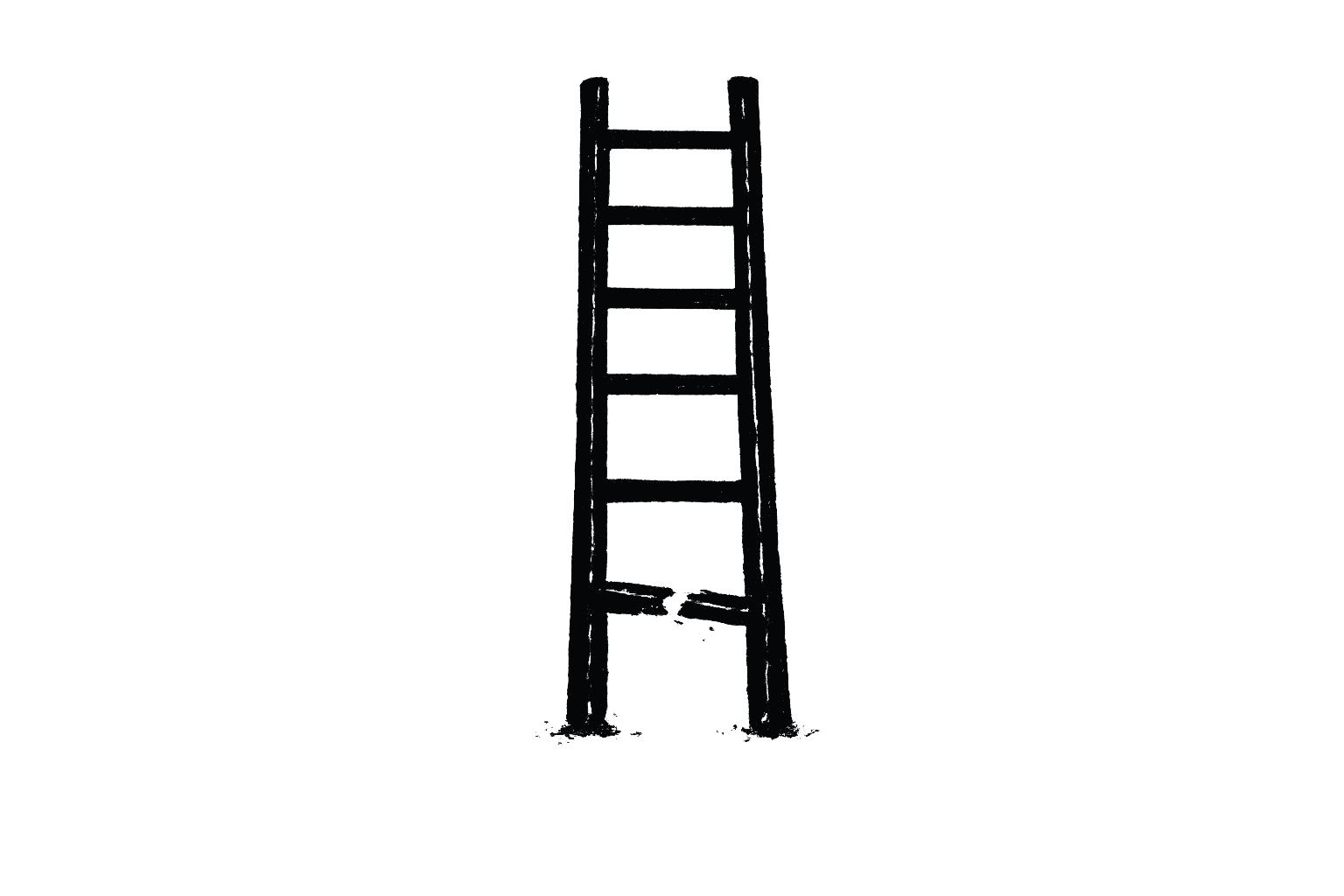
The juniors don't have that yet. They were supposed to be building it right now, on the boring tasks, the grunt work, the first drafts. Except AI does the grunt work now. So we've quietly sawn off the bottom rung of the ladder that turned novices into masters.
We've built a world where a twenty-two-year-old can produce the output of an expert without ever paying the tuition of becoming one.
And here's the trap, laid bare: the day the machine makes its one subtle, confident, catastrophic mistake, and it will, the only person who can catch it is someone who did the hard years. Someone who knows in their bones that the answer smells wrong.
We are at risk of raising a generation of overseers who cannot oversee.
So no, I'm not going to fight the tide and ban the thing from my house. That war is lost, and it's the wrong war anyway.
The goal was never to keep my daughters away from AI. The goal is to raise young women who can stand beside it, and never once mistake it for a place to lean.
Here's David Autor, an economist at MIT: AI is "useful to extend what you know, but not a substitute for knowing nothing."
That's the sentence I want tattooed on my kids.
A crutch takes your weight. A tool sharpens your hand. They look identical in the moment. They are opposites over a lifetime.
So this is what I'm actually trying to teach three girls under fifteen:
- Struggle first. Sit in the not-knowing. Sweat the problem before you ever reach for the answer. The ache is not a bug. The ache is the muscle forming.
- Go deep in one true thing. Critical thinking isn't a free-floating skill you can download. You can only think critically about something you deeply know. So know something all the way down. History. Cello. Netball. Anything, as long as it's real and it's hard.
- Trust nothing it tells you. Treat every answer as a confident stranger's first guess. Check it. Catch it lying. Make suspicion a reflex.
- Get off the screen and into a body. The skills the machine can't fake, reading a room, holding a friend through a bad week, leading people who don't have to follow you, those grow in playgrounds and rehearsals and part-time jobs. Not in a feed.
That's not resistance to AI. That's the training to become symbiotic with it.
Now, the uncomfortable part.
Yes. I used AI to write this.
I felt you flinch. Fair.
But here's exactly how. I didn't ask it what to think. I dragged this argument out of myself first. The fear at that kitchen table was mine, whole and aching, long before any machine touched it. Then I sent an AI into the world to fetch me the studies, the numbers, the names. I made it my research assistant. I never let it become my ghost.
It sharpened the blade. It never held the knife.
And that, that exact line, between the tool that extends you and the crutch that erodes you, is the only thing worth teaching a child right now.
I want my daughters to use these machines like I just did. Fiercely, sceptically, in service of a mind that did the hard part first.
Not the other way around.
Now, one for the leaders reading.
That broken bottom rung isn't only in my kitchen. It's in your building.
Every time you route a junior designer's rough draft, a strategist's first cut, a writer's early lines to a machine because it's faster, ask the quieter question: what was that junior supposed to become by doing it? You are not just shipping work. You are growing the next generation of judgement, or failing to.
The way we treat AI at our desks is teaching our teams, and our children, by example, how to treat it at theirs.
So I'll leave you where I started. At a kitchen table, watching a fourteen-year-old's hand drift towards the easy answer.
I let her reach it, that night. But then I made her close the phone and do the next one cold.
She was furious with me.
It might be the kindest thing I've ever done for her.
Where are you letting people skip the struggle, at your kitchen table, or in your building? I'd genuinely like to know. That's the leadership conversation I think we're all avoiding.
Sources, for anyone who wants to check my working
- 17% worse exam scores after unrestricted GPT-4: Bastani et al., "Generative AI Can Harm Learning," PNAS (2025), randomised trial, ~1,000 students. The study also found a guardrailed AI tutor eliminated the harm. The tool wasn't the villain; unrestricted reliance was.
- "Cognitive debt" and 78% unable to quote their own essay: Kos'myna et al., "Your Brain on ChatGPT," MIT Media Lab (2025), EEG study of 54 participants across four months.
- 13% relative employment decline for 22 to 25-year-olds in the most AI-exposed jobs: Brynjolfsson, Chandar & Chen, "Canaries in the Coal Mine?", Stanford Digital Economy Lab (2025), based on ADP payroll data.
- Tacit knowledge and why older workers are spared: Erik Brynjolfsson, quoted in Fortune, August 2025.
- "Extend what you know, not a substitute for knowing nothing": David Autor, MIT.
- Desirable difficulties: Bjork & Bjork, decades of learning-science research on productive struggle.
- Critical thinking is not a transferable, free-floating skill: Daniel Willingham, cognitive scientist, University of Virginia.
- In-person social time collapse among teens: Jonathan Haidt, The Anxious Generation (2024).
One honest caveat: five-to-fifteen-year forecasts about jobs are unreliable, and I don't pretend otherwise. But the core advice, struggle first, know something deeply, verify everything, live in the real world, holds up even if every specific prediction here turns out wrong. That's rather the point.
Stay sharp.
Field notes from the front lines. Weekly.
By clicking Sign Up you're confirming that you agree with our Terms and Conditions.